A note from Mozhgan Taheri, founder of Sci-U Clinic
I have some news I’ve been so excited to share with you. Sci-U Clinic is now home to Sarah Griffiths of Nourish, our in-house functional nutritionist, who will be with us every Wednesday. Sarah is bringing advanced gut health testing to the clinic for both adults and children, and together we are building something I’ve wanted to offer for a long time: a true 360° approach to your skin and your wellbeing.
Please join me in giving Sarah the warmest Sci-U welcome.
Why I wanted Sarah on the team
After many years of treating skin, there is one pattern I see again and again. Some clients do everything right. They follow their homecare, they come in for their treatments, they protect their skin from the sun, and yet their acne keeps flaring, their redness keeps coming back, or their skin just never looks as calm and bright as it should.
Very often, when we talk a little more, the same things come up: bloating, an unsettled tummy, irregular digestion, feeling tired all the time, or a diet that has drifted while life got busy. The skin is our largest organ, and in my experience it is often the first place that tells us something is going on inside.
I can do a great deal for your skin from the outside. But I have always believed the best results come when we look at the whole person. That is exactly why I wanted Sarah here. She looks at what is happening on the inside, I look after what is happening on the outside, and we work on it together.
The gut-skin connection: what the research says
Scientists call the link between our digestive system and our skin the gut-skin axis. Your gut is home to trillions of bacteria, fungi and other microbes, known as the gut microbiome. These microbes help to digest food, produce useful compounds such as short-chain fatty acids, and play a big part in training and calming the immune system. When this community is out of balance (often called dysbiosis), or the gut lining is not working as well as it should, research suggests the effects may show up well beyond the gut, including in the skin.
This is a fast-moving area of science and there is still a lot to learn, but here is what some of the research has found so far:
- Rosacea. In a 2008 study, around 46% of people with rosacea had small intestinal bacterial overgrowth (SIBO), compared with just 5% of people without rosacea. When the overgrowth was treated, most saw their skin clear or greatly improve, and the improvement lasted at least nine months. A large Danish study of more than 4 million people also found that people with rosacea were more likely to have coeliac disease, Crohn’s disease, IBS and ulcerative colitis.
- Acne. Doctors first suggested a link between the gut, stress and acne back in 1930. Since then, researchers have explored how stress, diet and changes in gut bacteria might drive inflammation that shows up in the skin. The evidence here is still developing and many studies are small, but the gut-brain-skin connection is now taken seriously by researchers.
- Eczema (atopic dermatitis). People with eczema have been found to have lower levels of certain beneficial gut bacteria and fewer of the short-chain fatty acids those bacteria produce. In babies, one study found that those with lower gut microbial diversity in their first month of life were more likely to go on to develop eczema.
- Psoriasis. Psoriasis is more common in people with inflammatory bowel disease, and studies have found the gut bacteria of people with psoriasis often look different from those of people without it, with signs of a weaker gut barrier.
I want to be honest with you: much of this research shows a link, not proof that the gut is the cause of every skin concern. Skin is complex, and hormones, genetics, stress, sleep and skincare all play their part too. But for many people, supporting gut health is a missing piece of the puzzle, and it is one we can now look at properly here at Sci-U.
Gut health testing for adults
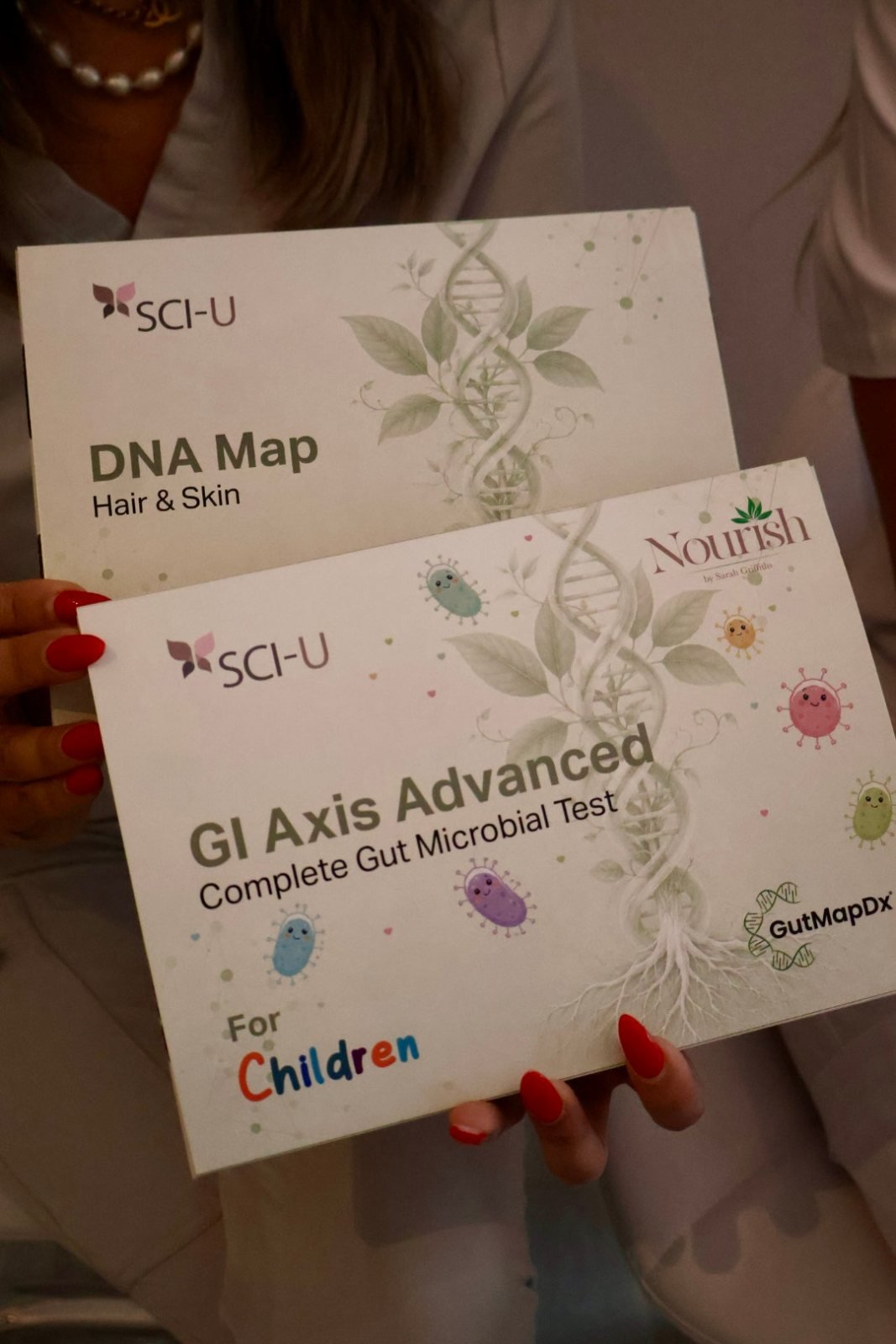
Rather than guessing what might be going on, Sarah uses the GI Axis Advanced gut microbiome test from GutMapDx. It’s simple and done in the comfort of your own home:
- Book your consultation with Sarah on a Wednesday at the clinic. She will talk through your health history, your digestion, your diet, your lifestyle and, of course, your skin.
- Collect your sample at home using the easy stool sample kit, then post it back to the laboratory in the prepaid packaging.
- The lab analyses your sample using DNA-based technology, looking at the balance and diversity of your gut bacteria, as well as screening for fungi, parasites and markers linked to digestion, inflammation and the health of your gut lining.
- Sarah takes you through your results in a follow-up appointment. She explains what they mean in plain English and creates a personalised nutrition plan to support your gut, which may include food changes and targeted supplements.
Gut testing can be helpful if you live with ongoing bloating, an irregular or unsettled tummy, low energy, or a skin concern that has not responded the way you hoped to treatment alone.
Gut health testing for children
As a clinic, we are so proud that we can now support the whole family. Sarah also offers a children’s version of the GI Axis Advanced test, designed specifically for little ones with age-appropriate reference ranges, so results are compared against what is normal for a growing child rather than an adult.
Parents often come to us when their child is dealing with things like:
- eczema or dry, irritated skin that keeps coming back
- tummy aches, bloating or constipation
- loose or irregular stools
- being a fussy eater, or reacting to certain foods
The early years are such an important time for the gut microbiome, which is still developing and helping to shape how the immune system works. Sarah’s approach for children is gentle and practical. The sample is collected at home, and her recommendations focus on realistic food and lifestyle changes that work for family life.
Gut testing for children is designed to work alongside your GP or paediatrician, never instead of them. If your child is unwell or you are worried about their health, please always speak to your GP first.
Our new 360° approach to your skin
This is the part I am most excited about. For clients who want to work on both the inside and the outside, Sarah and I will now work together on your care:
- Skin consultation with me. We start by looking closely at your skin, your concerns and your history, so I understand exactly what we are working with.
- Gut health consultation and testing with Sarah. Sarah carries out your gut test and builds your personalised nutrition plan from your results.
- Your bespoke skin treatment package. With Sarah’s findings in mind, I design an in-clinic treatment plan that works alongside your nutrition plan. Depending on your skin, this might include treatments such as Hydrafacial, LED light therapy, medical-grade peels or microneedling, together with the right homecare products. If your skin is inflamed or reactive, for example, we focus first on calming and strengthening it before moving on to more intensive treatments.
- Review together. We check in on your progress, see how your skin and digestion are responding, and adjust the plan as you go.
Two experts, one plan, built entirely around you. Instead of treating your skin in isolation, we look at the whole picture and give your skin the best possible chance to look and feel its healthiest, for the long term.

Who is this for?
Our 360° gut and skin approach may be a good fit if you:
- have acne, rosacea, eczema, redness or sensitivity that keeps returning
- have tried treatments before but feel the results have not lasted
- also notice bloating, an unsettled tummy or low energy
- want a more natural, whole-body approach to looking after your skin
- are a parent looking for support with your child’s gut health or skin
A quick but important note
Gut microbiome testing is a wellness tool. It gives Sarah valuable insight into your gut health, but it is not a medical diagnosis and does not replace your GP. If you notice blood in your poo, unexplained weight loss, or a change in your bowel habits that lasts three weeks or more, please see your GP straight away.
Come and meet Sarah
Sarah is with us at Sci-U Clinic in Wilmslow every Wednesday. If you would like to book a gut health consultation for yourself or your child, or you are interested in our 360° gut and skin package, get in touch with our team or book a consultation online and we will guide you through the next steps.
I truly believe this is the future of skincare: looking after you from the inside out. I can’t wait for you to meet Sarah.
With love,
Mozhgan
Founder, Sci-U Clinic
References
- Parodi A, et al. Small intestinal bacterial overgrowth in rosacea: clinical effectiveness of its eradication. Clinical Gastroenterology and Hepatology. 2008;6(7):759-64.
- Egeberg A, et al. Rosacea and gastrointestinal disorders: a population-based cohort study. British Journal of Dermatology. 2017;176(1):100-106.
- Bowe WP, Logan AC. Acne vulgaris, probiotics and the gut-brain-skin axis: back to the future? Gut Pathogens. 2011;3:1.
- Salem I, et al. The gut microbiome as a major regulator of the gut-skin axis. Frontiers in Microbiology. 2018;9:1459.
- Abrahamsson TR, et al. Low diversity of the gut microbiota in infants with atopic eczema. Journal of Allergy and Clinical Immunology. 2012;129(2):434-440.
- Chen J, et al. Psoriasis and gut microbes: research advances from mechanism to therapy. Frontiers in Microbiology. 2025;16.